

Truck Expert | Autofastera • March 10, 2026 • Reading time: ~6 min
A truck battery is not something you think about in advance. You think about it at 5 AM when the truck won’t start before a run. Here we break down how long popular brands actually last, why batteries die early, and what you can do about it.
How long does a truck battery actually last
The average stated service life for heavy-duty batteries from leading manufacturers is 4–5 years. The real picture across the Ukrainian and Eastern European market looks different:
Average service life by brand (commercial vehicles, real-world operation)
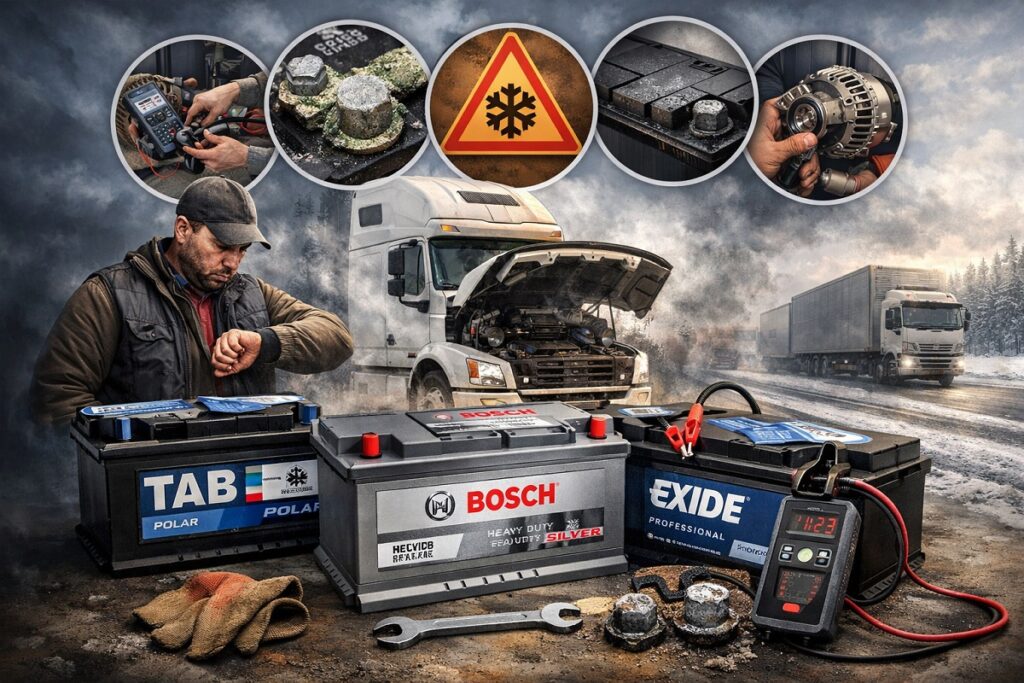
TAB (Slovenia)
Real-world life: 3.5–5 years
TAB is one of the few European manufacturers with its own lead plate production. The TAB Polar and TAB Magic ranges are specifically engineered for commercial vehicles in cold climates. Handles deep discharge well, delivers stable cold cranking current in freezing temperatures. On the Ukrainian market, TAB consistently shows one of the best price-to-lifespan ratios in the heavy-duty battery segment.
Bosch (Germany)
Real-world life: 3–4.5 years
A strong brand with rigorous production quality control. The HeavyDuty range is designed for high-draw commercial applications. Sensitive to systematic undercharging — on short urban routes it degrades faster than its rated life.
Varta (Germany / Johnson Controls)
Real-world life: 3–4.5 years
Manufactured on the same production lines as Bosch — comparable quality. The Promotive Blue/Black range performs well on long-haul tractors. Same weakness as Bosch: short urban duty cycles with frequent brief starts.
EXIDE (USA / Europe)
Real-world life: 2.5–4 years
Wide product range with significant quality variation depending on country of manufacture. The Heavy Professional series is reliable; the budget series is considerably weaker. Always check the country of manufacture on the label before buying.
Why batteries die early: 6 real causes
1. Systematic undercharging
The number one killer of truck batteries. It occurs when the truck operates on short routes — the alternator does not have enough time to restore the charge after each start. The battery runs continuously at 70–80% charge. Plate sulphation begins within 3–4 months — capacity drops permanently.
High-risk fleet types: urban delivery trucks, refuse vehicles, municipal service vehicles.
2. Parasitic current drain
Modern trucks with ECUs, tachographs, and telematics systems draw 20–80 mA even with the engine off. After 2–3 weeks parked without a top-up charge, the battery reaches deep discharge. A single deep discharge below 10.5 V reduces battery service life by 15–30%.
High-risk fleet types: vehicles with extended downtime, seasonal equipment, fleets without charge monitoring during storage.
3. Vibration damage
Truck batteries are subjected to significantly higher vibration loads than passenger car units. Internal plate fracture and active mass shedding are common failure modes in vehicles operating on unpaved roads or construction sites. The battery looks fine externally, voltage is present, but capacity has dropped to 40–50%.
High-risk fleet types: tipper trucks, construction machinery, agricultural transport.
4. Overheating in the engine compartment
Optimal battery operating temperature is 0°C to +25°C. Sustained exposure above +40°C accelerates self-discharge, causes electrolyte evaporation, and speeds up plate corrosion. Every 10°C above the optimum roughly halves service life.
5. Faulty alternator or voltage regulator
Charge voltage above 14.8 V means overcharging — electrolyte boils off, plates warp. Voltage below 13.8 V means the battery is chronically undercharged. Both conditions destroy a battery in 1–1.5 years instead of 4–5. An alternator check costs $10–20 — ignoring it costs $200–500 for a new battery.
6. Poor installation and terminal condition
Corroded terminals create resistance — during cranking the terminal voltage drops further than it should, leaving the ECU and starter motor short of current. Cleaning terminals once a year is free preventive maintenance that is routinely overlooked.
How to maintain a truck battery correctly
Every 3 months
- Check terminal voltage with engine off — normal range 12.6–12.8 V
- Inspect the case for cracks and swelling
- Clean terminals of corrosion — baking soda solution and a wire brush
Every 6 months
- Check alternator charge voltage at idle — normal range 13.8–14.5 V
- Test cold cranking current with a load tester — should match the CCA rating on the label
- On maintainable batteries, check electrolyte level
Before extended parking (2 weeks or more)
- Connect to an automatic battery maintainer in trickle charge mode
- Or disconnect the negative terminal — if no alarm or tachograph requires continuous power
- Before the winter season — capacity and CCA test is mandatory
Winter preparation
- A fully charged battery freezes at −60°C; a 50% discharged battery freezes at −10°C
- Charge to full with a mains charger before the cold season begins
- Batteries over 3 years old — load test is essential, do not wait for a cold-weather failure
How to choose a replacement battery: what to look for
Capacity (Ah) — not less than the original fitment. Going 10–20% higher is acceptable and beneficial on short-route operations.
Cold Cranking Amps (CCA) — for diesel trucks with 10–13 litre engines: 900–1000 CCA minimum, 1100–1250 CCA optimal.
Technology — vehicles with Start/Stop and recuperation require EFB or AGM. A standard calcium battery in such a truck will not last 2 years.
Date of manufacture — a battery more than 6 months from its production date has already lost some capacity. Check the date code on the label when buying.
Summary
A good battery does not guarantee 5 years on its own — it gets killed by undercharging, vibration, heat, and a faulty alternator. Brand matters, but how you operate and maintain the battery matters more.
TAB, Bosch, and Varta with proper maintenance genuinely reach 4–5 years. The same batteries on urban duty cycles without charge monitoring last 2–2.5 years. The difference is not the battery — it is how it is treated.
To find the right battery for your truck by make, model, and year — use the Truck Expert system from Autofastera.
Frequently Asked Questions
How long does a truck battery last?
With proper maintenance — 4–5 years. On urban duty cycles without charge monitoring — 2–2.5 years. Service life depends less on the brand and more on operating conditions and alternator health.
Why does a truck battery die before its time?
The main causes are systematic undercharging on short routes, parasitic drain during extended parking, vibration damage, and a faulty alternator. Summer overheating is a separate factor — every 10°C above the optimum roughly halves battery life.
Which battery is best for a truck in Ukraine?
TAB Polar or TAB Magic — the best price-to-lifespan choice for Ukrainian operating conditions. The range is engineered for cold climates and rough road surfaces.
What CCA rating do I need for a diesel truck?
For 10–13 litre engines: 900–1000 CCA minimum, 1100–1250 CCA optimal. The colder the operating region, the more important it is to have headroom on cold cranking performance.
Can I fit a higher-capacity battery on a truck?
Yes — going 10–20% above the original Ah rating is acceptable and beneficial, especially on short-route operations. The only constraint is the physical size of the battery tray.
How do I know when a truck battery needs replacing?
Signs: engine cranks noticeably slower than usual, battery does not hold charge after parking, load tester shows voltage dropping below 9.6 V under load, battery is over 4 years old. Do not wait for a failure — test before the winter season.
Data source: Truck Expert (Autofastera)
Analysis is based on battery service statistics from commercial vehicle fleets operating in Ukraine and Eastern Europe, combined with manufacturer data from TAB, Bosch, Varta, and Exide.
Content prepared by the Truck Expert parts identification system.